Leadership software for people managers

You can’t keep everything in mind.Let Emily.

You care about every person you lead. You cannot hold every commitment, goal, worry and half-finished conversation in active memory while a week of meetings runs over the top of it. Emily can. She keeps the context behind every person on your team connected over time, and brings back what deserves your attention before it matters, not after.

Free to start. No credit card required.

Free forever · Cancel Pro anytime

She keeps the context. You lead the person.

What is LetEmily?

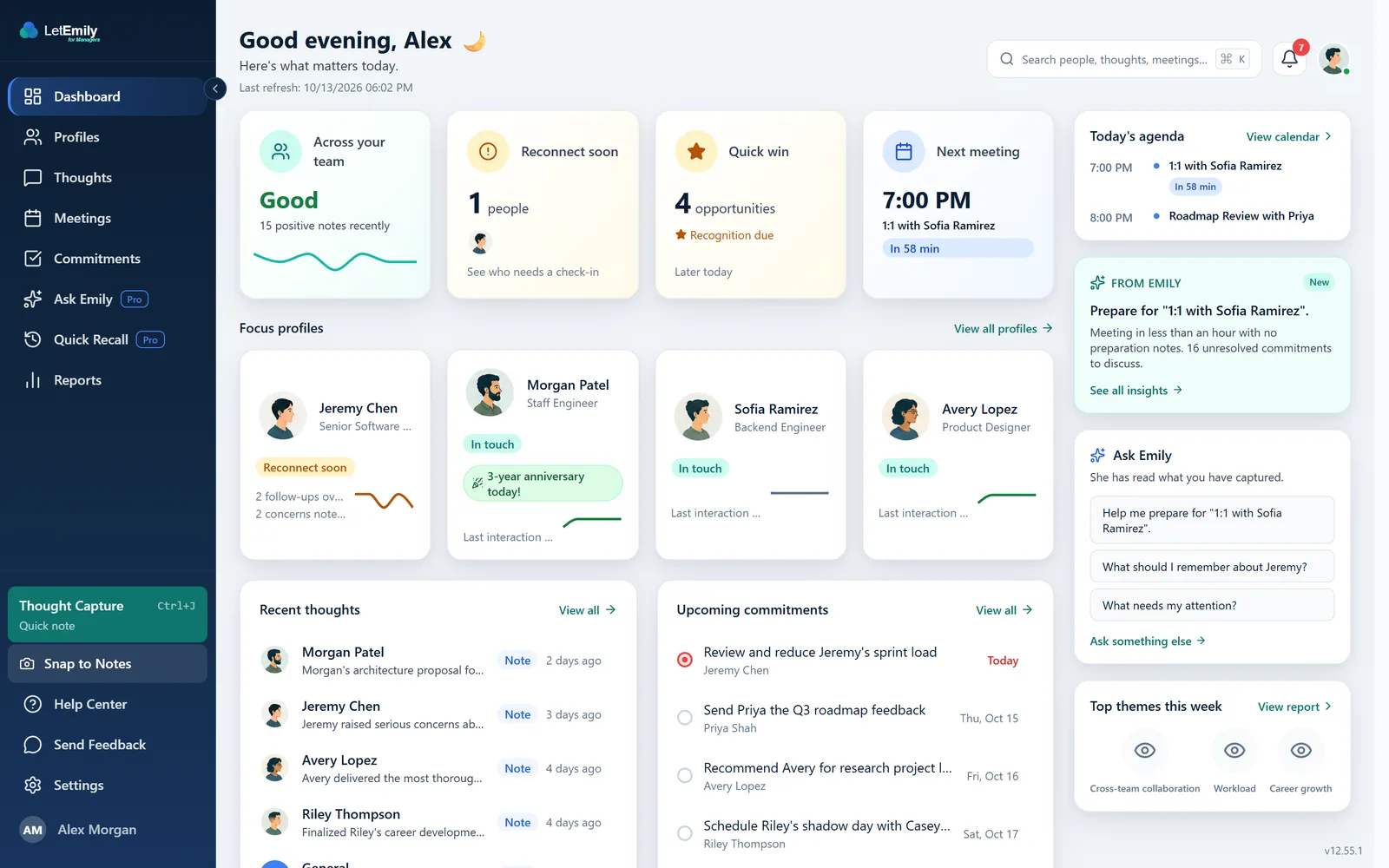
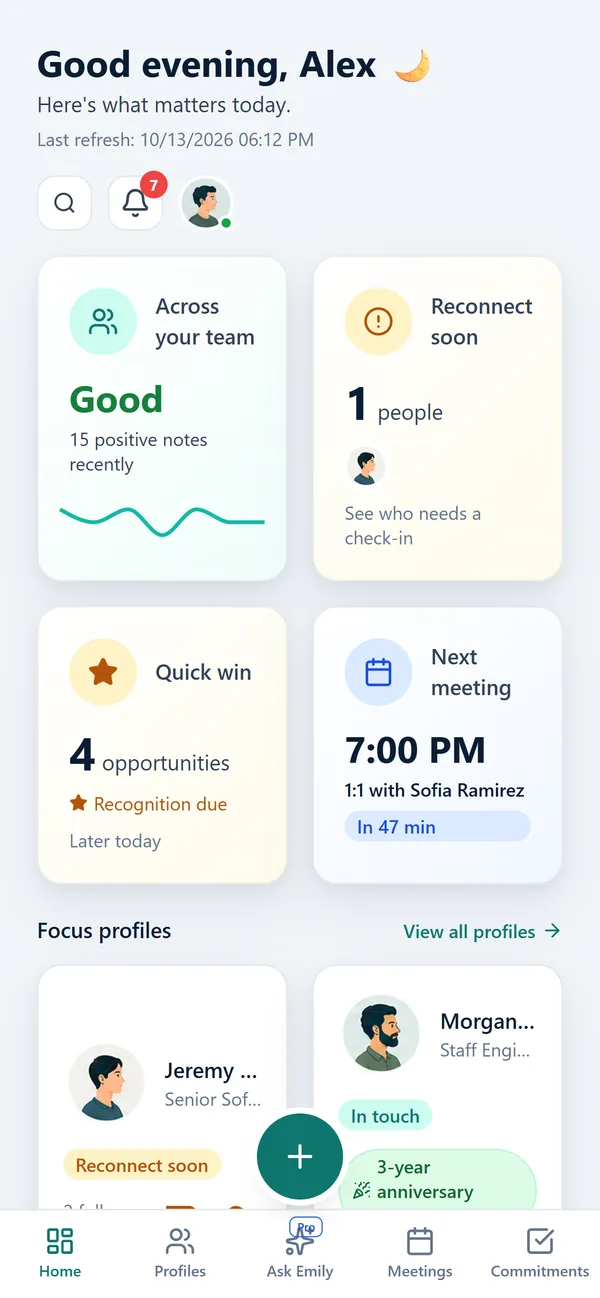
LetEmily is people management software for managers who care about their team but cannot keep every conversation, commitment, and goal active in mind at once. Emily, the intelligence inside LetEmily, holds that context, gathered from calendar meetings, quick notes, Slack, team introductions, and your own weekly reflections, and keeps it connected across months. She prepares you before a 1:1, resurfaces commitments before they slip, answers questions from your own team context, and points out things worth noticing: an open thread, a recurring topic, someone you have not spoken with in weeks. Emily handles the remembering and the connecting; the judgment, the feedback, and the relationship stay with you. LetEmily is free to start and never trains AI models on customer data.

The name is the idea. Emily is the one doing the remembering, the connecting and the noticing. Let is the part that matters most: this is work you are allowed to put down. Not the relationship, not the judgment, not the hard conversation, the cognitive overhead wrapped around them.

Who it is for
People managers who run regular 1:1s and want to develop the people they lead: team leads, engineering and product managers, directors, and founders who manage directly. Who LetEmily is for
What it helps you do
Arrive prepared, continue a conversation rather than restart it, keep the promises you made, notice what has gone quiet, and see where your attention actually went. How it works
How the context reaches Emily
Your calendar, one-line notes you write in the app or straight from Slack, and introduction forms your team fills in themselves. Emily can only help with context she has, so getting it to her costs seconds, not a documentation habit. Integrations
What it is not
Not a meeting recorder, not an engagement survey, and not a way to monitor, score, or rank your team, or you. How it differs

Attention is the thing you actually run out of.

Not care, and not competence. There is simply more context attached to a team than one person can hold in mind at the same time.

  • What someone said they wanted to be doing in a year
  • The skill they asked for help building, back in March
  • A promise you made in a 1:1 and fully meant to keep
  • Progress worth naming out loud before they start doubting it
  • The person who has not really talked to you in a month
  • The hard conversation you keep deciding to have next time

None of this slips because you stopped caring. It slips because your attention is being spent somewhere else: on delivery, an incident, hiring, a reorg, the other five people, and human context is the only thing in your week that nothing is holding on your behalf. So the 1:1 restarts instead of continuing, the promise quietly expires, and a year of conversations adds up to less than it should have.

Three sentences most managers say to themselves

Each of them is the same problem wearing different clothes, and each has the same answer.

  • I cannot possibly hold all of this in my head.Let Emily.
  • I need to know where we left off last time.Let Emily.
  • Six 1:1s tomorrow and no time to prepare.Let Emily prep you.

How Emily gives you back the attention

Holding the context is the easy half. What matters is what it lets you do with the person sitting in front of you.

1

Context comes in

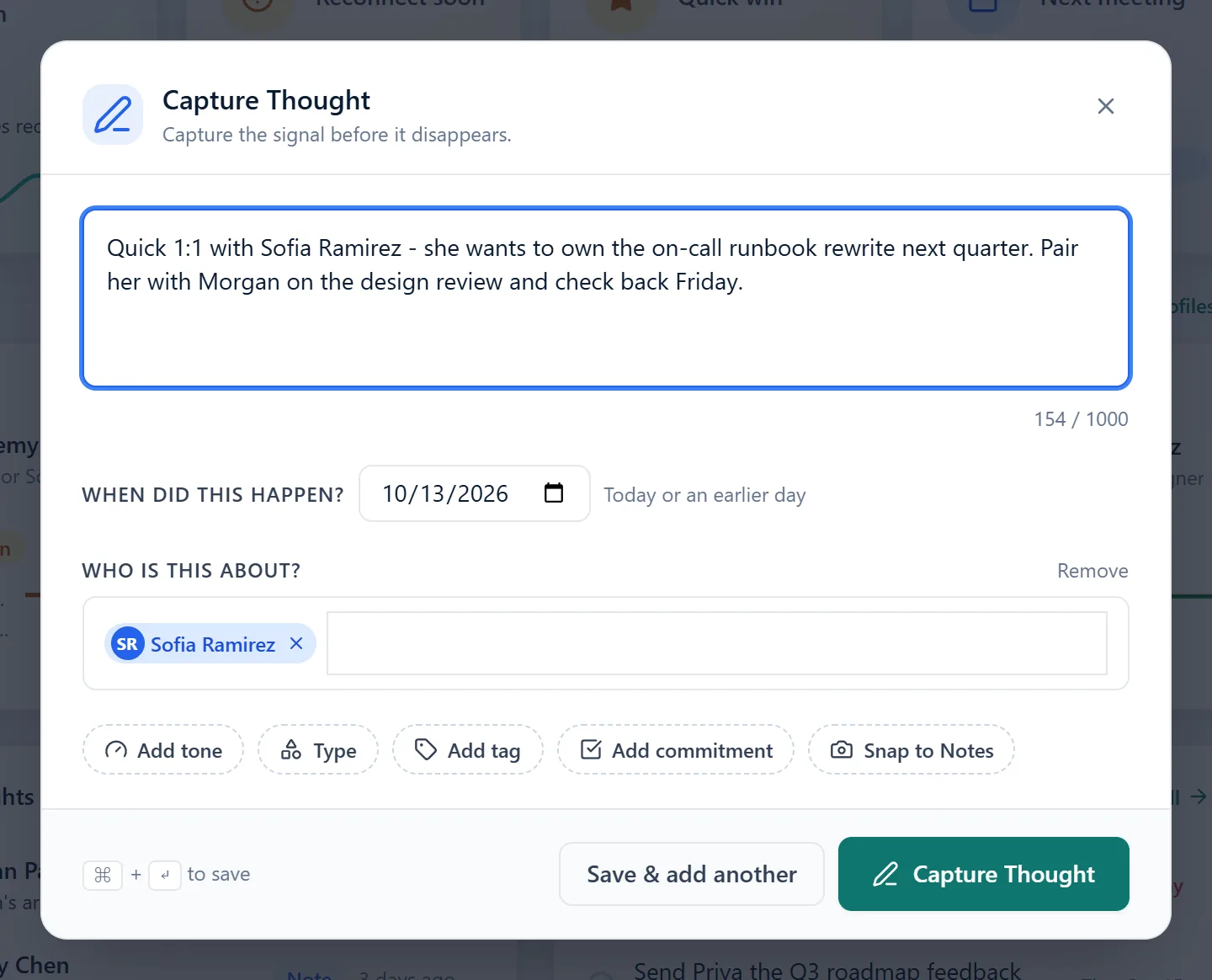
A line after a 1:1, a promise as you make it, a meeting from your calendar, an introduction in someone’s own words. Seconds, not a documentation habit, and you can do it without leaving Slack.

2

Emily keeps it connected

Every piece attaches to the person it belongs to, so a working relationship accumulates in one place instead of scattering across tools. Nothing to file, tag, or sort. This is the memory layer, and it is what makes everything after it possible.

3

Emily brings back what matters

What is still open between you, what has changed for someone, what has been sitting untouched too long, which theme keeps recurring across the team. Things worth noticing, never verdicts about people.

4

You give it your attention

Walk in knowing where you left off, what they are working toward, and what you owe them. The conversation continues rather than restarts, and the time goes into the person instead of the reconstruction.

5

Over time, you lead more deliberately

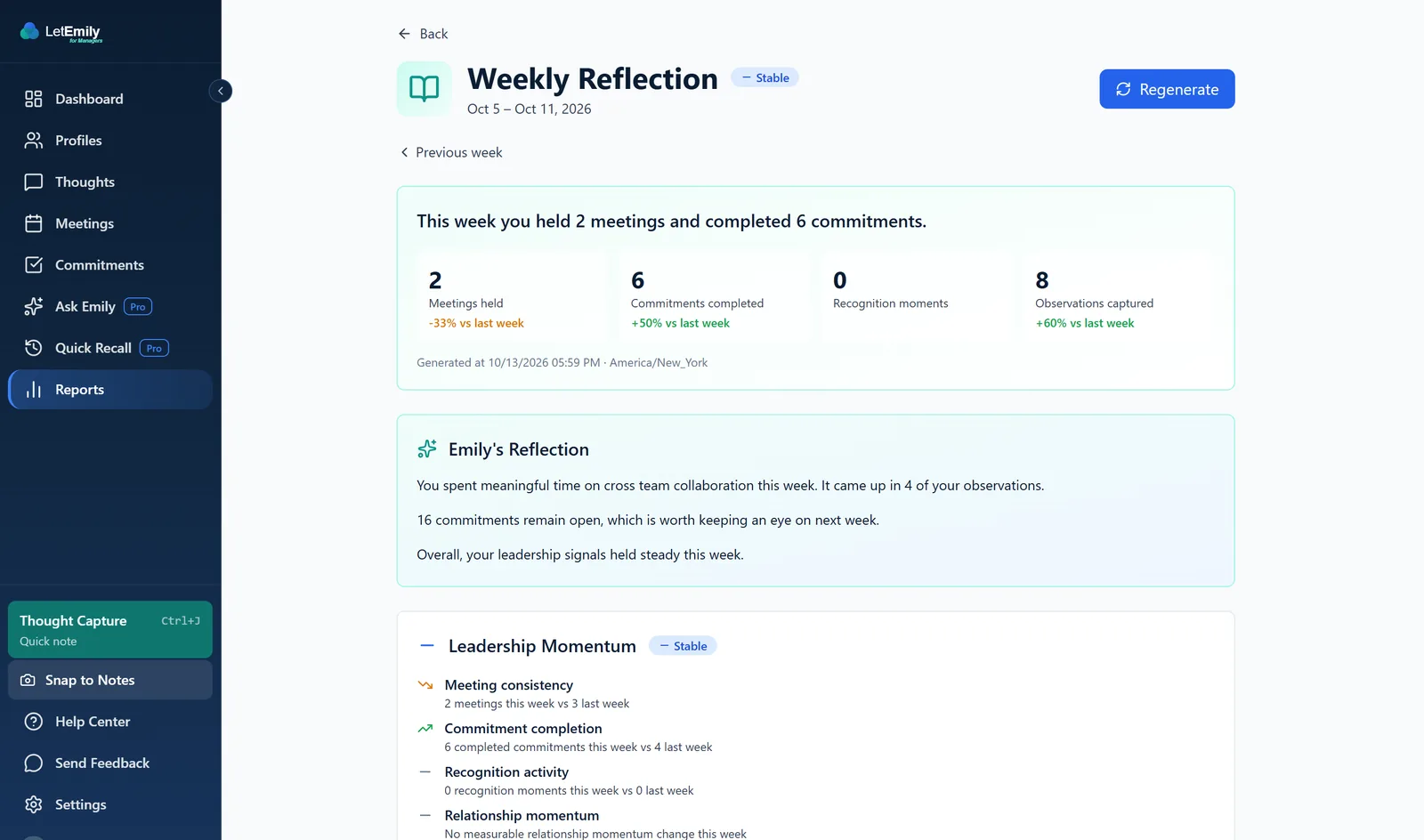
Once a week, step out of the meeting-by-meeting view: who you have actually spent your attention on, what you committed to, what keeps coming up. That is where managers get better, and it is the part almost nothing else makes room for.

Leadership happens between the meetings, too.

Emily works the way your week actually runs: before, during, after, and across the months where growth actually shows up.

Before: Walk in already remembering.

A short brief with the last conversation, what is still open between you, and what has changed for that person. No scrambling through old notes at 8:58, and a first question that proves you were listening in March.

During: Keep your attention on the person.

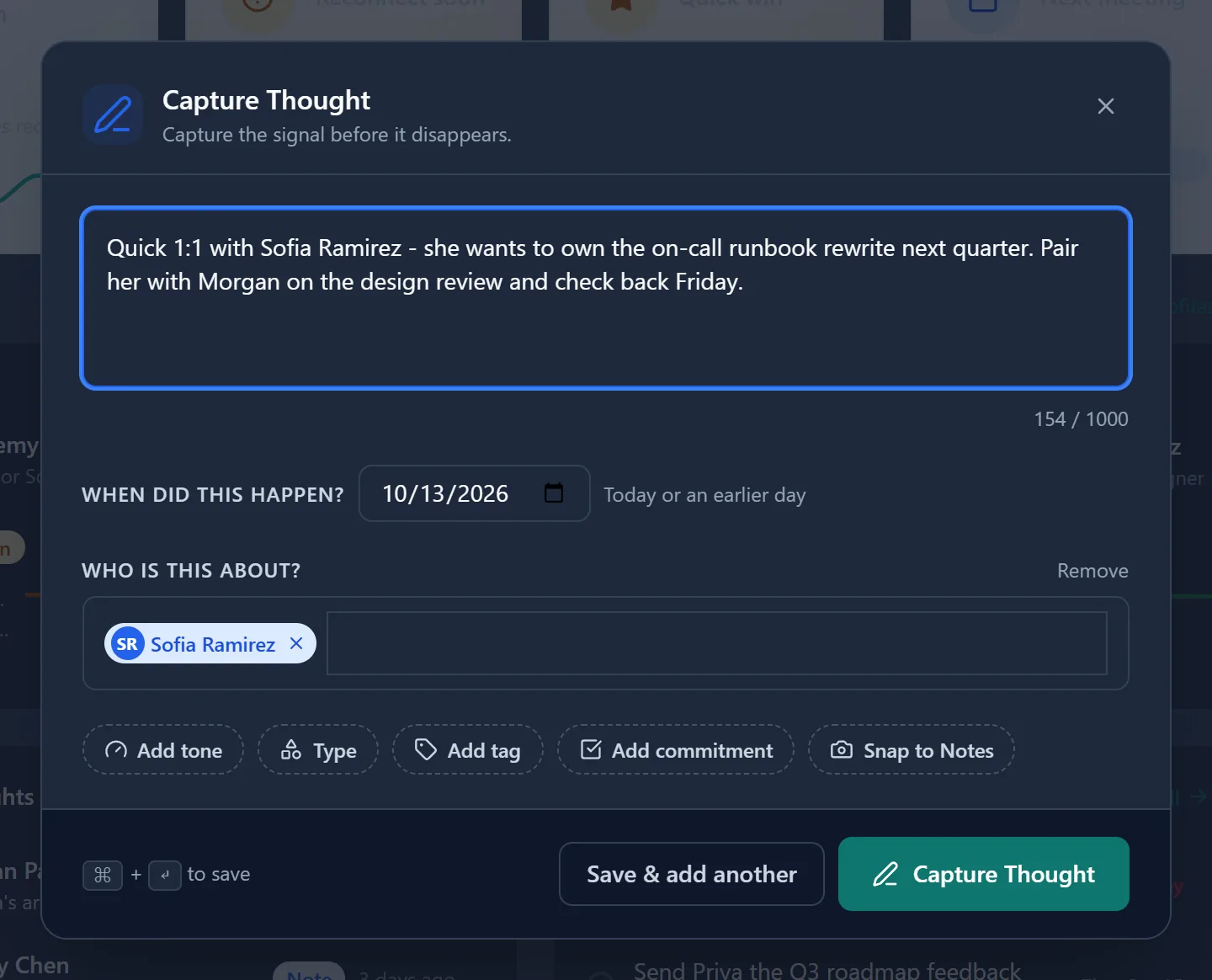
Capture a thought or a follow-up in a few seconds without turning the meeting into a documentation exercise. The person in front of you should have your attention, not your typing.

After: Do what you said you would do.

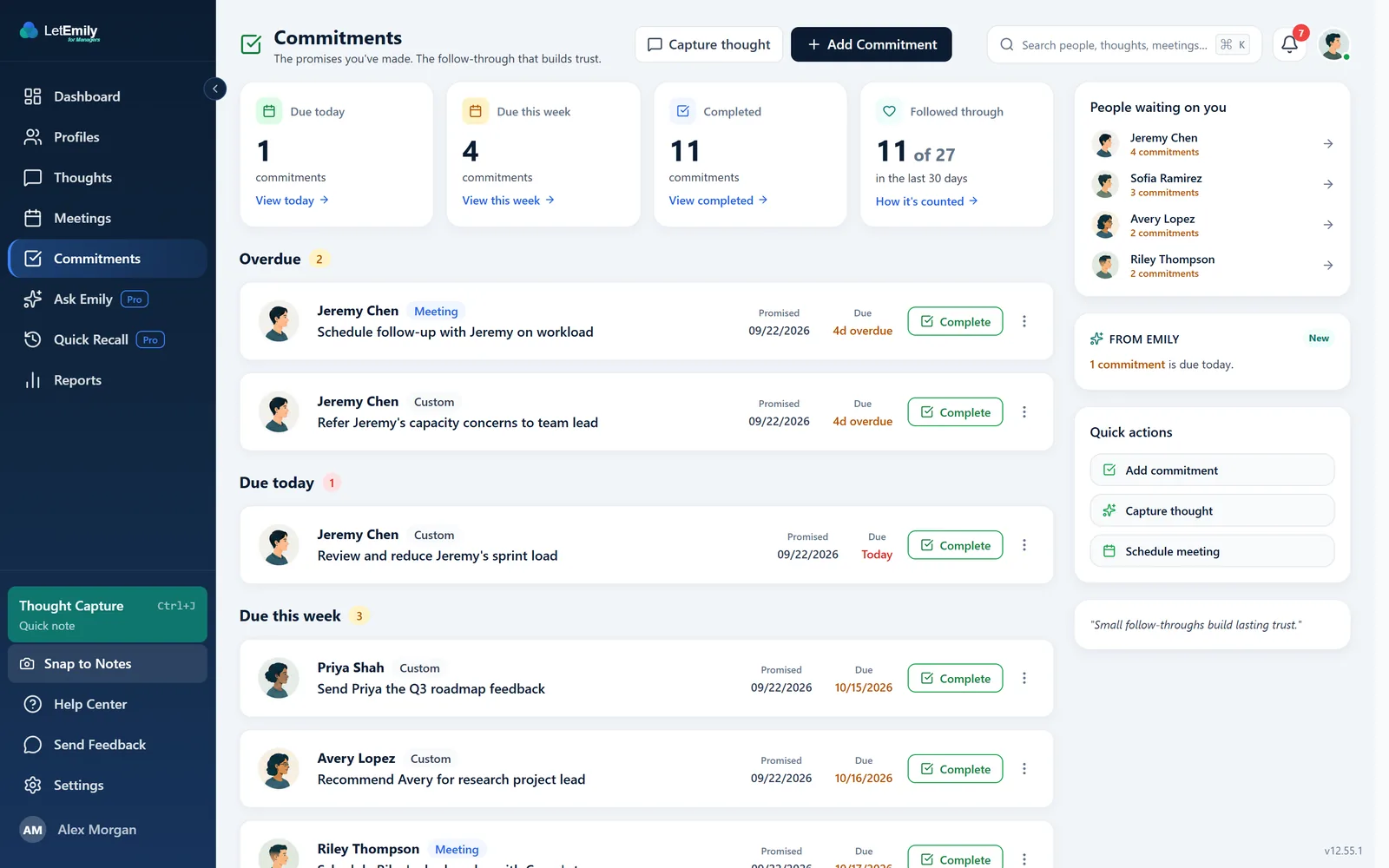
Commitments stay visible and come back before they quietly become broken promises. Follow-through is the one management quality your team can actually verify, and it is built one small kept word at a time.

Over time: See what a single week cannot show you.

Moments become history, and history makes things legible: what someone has moved past, the challenge that keeps recurring, the goal that has quietly drifted, and where you might help next.

Better attention is how managers get better

Most management advice assumes you can see your own patterns. You cannot, really, not from inside a week made of thirty meetings. The record of how you actually led is the only honest mirror there is, and until now nobody kept one.

Emily keeps it as a by-product of the work, and hands it back once a week.

  • See where your attention actually went this week, not where you assumed
  • Notice the conversation you keep postponing
  • Keep development goals from quietly disappearing between check-ins
  • Learn what different people need from you, from what they told you
  • Watch your own follow-through instead of estimating it

What you get is a fact and a prompt: “you have not had a real conversation with Sam in three weeks”, never a rating. There is no leadership score here, and there is not going to be one. Something worth noticing is more useful than a number, and a lot more honest about what software can actually see.

The intelligence behind LetEmily

Meet Emily

Emily isn't a chatbot you have to go talk to. She works from the leadership context you have already gathered, which is why she can tell you what is still open with a specific person, rather than offer general advice about 1:1s.

Prepares you

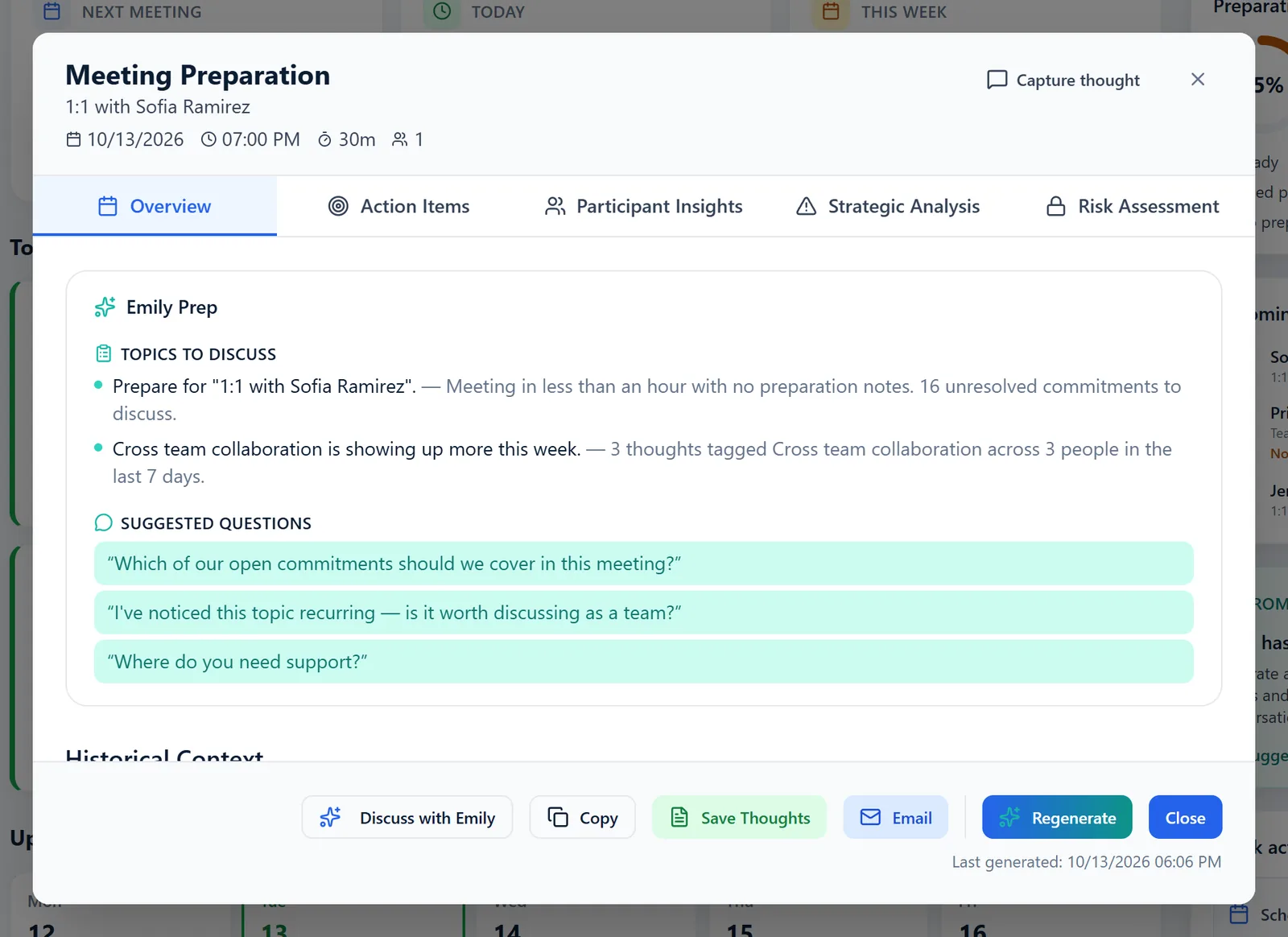
A short brief before each 1:1: last conversation, open commitments, and what has changed for that person.

Surfaces what matters

Things worth noticing across your team, and in how you have been leading it: easy to miss when you are moving meeting to meeting. Never a verdict about anyone.

Notices what slips

Follow-ups and commitments resurfaced before they fall through the cracks.

Answers what you ask

“What did Priya and I land on last month?” “Who haven’t I met with in three weeks?” Ask Emily, instead of digging.

From Emily: before your next 1:1

1:1 with Jordan • Tomorrow at 2:00 PM

Last time, Jordan raised the on-call rotation: worth revisiting.
You committed to sharing the promotion timeline. Still open.
Jordan shipped the migration this week: worth acknowledging.

Fits the day you already have

Connect your calendar and Slack, and the context reaches Emily on its own, no extra admin, no switching platforms.

Slack

Capture notes, get reminders

Microsoft 365

Outlook Calendar sync, Teams links, OneDrive backup

Zoom

Meeting links only

Google Workspace

Calendar sync, Drive backup

Emily pays attention to context so you can pay attention to people

Emily works for you, from what you wrote down. She does not watch your team, read their messages, or track what they do. This is not employee surveillance, and it never will be.

No engagement scores, no rankings, no labelling anyone on-track or off-track: for your team or for you.

Your notes are your own workspace, and worth writing as though the person might one day read them.

Your team's context is not there to train AI models. It never has been.

Questions managers ask first

Short answers here; the full set is on the FAQ page.

What is LetEmily?

LetEmily is people management software for managers who care about their team but cannot keep every conversation, commitment and goal active in mind at once. Emily, the intelligence inside it: holds that context, keeps it connected across months, and brings back the parts that deserve your attention: before a 1:1, when a commitment is about to slip, or when something has been quietly sitting untouched.

Why is it called LetEmily?

Because of the sentence managers keep saying to themselves. "I can’t possibly remember all of this." "I need to know where we left off." "Six 1:1s tomorrow and no time to prepare." Every one of those has the same answer: let Emily. She is the part of the job that is cognitive overhead rather than leadership.

Is Emily just an AI chatbot for managers?

No. A general-purpose assistant can tell you how to run a good development conversation. Emily can tell you that Priya asked for architecture work in March, that you said you would get her into design reviews, and that it is still open. The difference is not the model: it is that she works from the accumulated context of your actual team.

Who is LetEmily for?

People managers who run regular 1:1s and care about developing the people they lead: team leads, first-time managers, engineering, product and design managers, directors, and founders who manage directly. It is one manager's workspace, not an HR system.

Does LetEmily record or transcribe my meetings?

No. It does not join calls or capture audio. It reads your calendar to know a meeting is happening and works from short notes you write yourself.

Is this a way of monitoring my team?

No, and it is built so it cannot become one. Emily works from what you wrote down, not from anything your team does. There are no engagement scores, no rankings, and no view about how anyone is performing: she surfaces something worth noticing and leaves the judgment to you.

Is my team's data used to train AI models?

No. LetEmily does not train AI models on customer data, and it is not sold or shared with advertisers.

More attention for the people who matter.

Free means free. No trial countdown. No credit card required.

Emily handles the overhead. You lead the person.

Remember less. Notice more. Lead better.

People grow unevenly, and so do the managers leading them. Emily gives you the context and the judgment stays yours: she is not here to score anyone, rate your leadership, or tell you who is performing.